01
ultimatum
nounA final demand: accept it, or face a stated consequence.
TRY IT IN A SENTENCE
The landlord gave us an ultimatum: pay by Friday or leave.
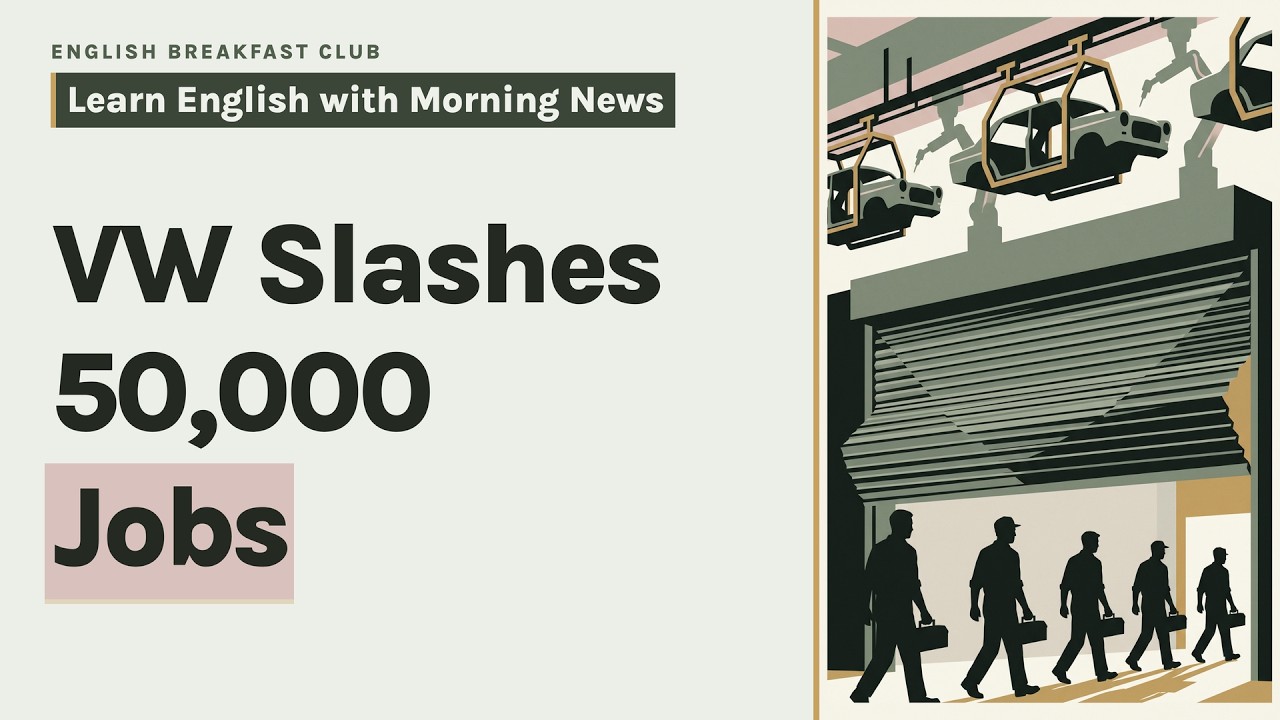
A five-story morning briefing: Volkswagen, the climate target, US welfare rules, smart rings and British politics. Build the English to talk about a changing world.
Press play to load YouTube’s video player. Or watch on YouTube ↗
From the episode, with fresh examples to help you use them. Save words on this device, then revisit them in your saved words.
A final demand: accept it, or face a stated consequence.
The landlord gave us an ultimatum: pay by Friday or leave.
A situation in which neither side can agree, so nothing moves forward.
A new proposal finally ended the deadlock between the two teams.
Gases or other substances released into the air.
The city wants to reduce traffic emissions by improving public transport.
Easily harmed, or needing extra protection.
Older residents can be especially vulnerable during a heatwave.
Earning more money than it costs to operate.
The small bakery became profitable in its second year.
Money or goods given to support a person, group or cause.
Local donations paid for new books at the community library.
Time, space or freedom to recover and think clearly.
YOUR TURN Extending the deadline gave our team room to breathe.
Give people more time to deal with a problem.
YOUR TURN A temporary repair could buy them time to find a replacement.
Preventing someone from doing something easily.
YOUR TURN Constant notifications are getting in the way of my reading.
Left an important job or position voluntarily.
YOUR TURN After ten years, the club president stepped down.
Complete narration from the episode. Number spelling follows the spoken script.
NarratorGood morning, club members! We digest world-class journalism and talk it through in plain English. Here are five stories worth your time. Volkswagen has agreed to cut fifty thousand jobs and close four factories in Germany. This is a massive change for the carmaker, because workers usually have half the seats on its board and can block plans like this. For years, company leaders wanted to reduce high German wage costs, but union leaders and regional politicians stopped them. This time, the bosses gave the unions an ultimatum. They warned that they would go straight to external shareholders and skip the board entirely. That had never happened before, and the threat finally broke the long deadlock. I find that move quite astonishing. It shows just how worried the carmaker really is about its survival. Volkswagen used to focus on making more cars than anyone else, but sales have dropped by two million vehicles since twenty nineteen. Chinese rivals are growing fast and selling electric cars for less money. Volkswagen simply cannot keep paying for factories that build more cars than people want to buy. So, how will these changes work in practice? The company plans to shut four German factories between twenty thirty-one and twenty thirty-four. It will also reduce its spending on new research and stop making some car models. Bosses hope this agreement will buy them time to fix the business and raise their profit margins. Yet closing factories does not solve every problem on its own. Volkswagen is still several years behind Chinese competitors in car software, and its electric models sell slowly in China. Cutting these jobs gives the firm room to breathe, but whether it can actually build the cars buyers want is far from certain.
NarratorFor our second story today, we turn to a big climate promise that has slipped away. United Nations scientists say the world cannot stop warming from passing one point five degrees. That number was the guardrail agreed upon eleven years ago to protect our planet. Hearing that we will cross it feels sobering to me, but the science is clear. Why has this target become impossible to keep? Scientists measure our safety by looking at a shared budget of carbon gas. Years ago, there was still room to burn fuel and change our ways gradually. Instead, pollution kept climbing around the world year after year. Now that budget has shrunk to just one hundred and thirty gigatonnes. At our current pace, the world will exhaust that allowance in roughly three years. Stopping in time would mean cutting all global emissions to zero in just over six years. Because that will not happen, we are entering what scientists call an overshoot era. Temperatures will climb beyond the target before they can ever come down. Small island nations pushed hardest for the original goal because higher water threatens their very homes. They point out that crossing the line brings permanent harm to vulnerable people. So, where does that leave us? The scientists stress that missing one point five degrees is not a reason to surrender. Every fraction of a degree still protects communities from worse storms and heat. The goal must now become pulling temperatures back down later through deeper cuts. There are even signs that global emissions might soon reach their peak. The old deadline is gone, but the race to prevent further harm is just beginning.
NarratorFor our third story today, we look at welfare rules in the United States. The American government has introduced strict new work rules for low-income families. Under these rules, adults must prove they are working to keep basic help like healthcare. Why are officials attaching these conditions to daily support? Supporters say work requirements help people move into jobs and build independence. But critics argue the main goal is simply to cut federal spending. When the rules become harder to follow, fewer families receive the support. I wonder what happens to someone who cannot easily find work. Thirty years ago, similar rules were introduced for cash assistance to poor families. Over three decades, the number of families getting cash dropped by more than three quarters. In some places, almost all applicants were turned away. Now, ministers are applying that same idea to healthcare and food help. If you do not meet the work standard, you lose your coverage. That leaves very poor households in a difficult bind. A person might need healthcare just to stay well enough to work. If they lose their doctor, getting a job becomes even harder. Some policy experts warn that these rules will push people into desperate work rather than stable careers. Cutting spending this way reduces the budget numbers on paper. But it also means fewer struggling families can rely on help when times are hard.
NarratorFor our fourth story this morning, a Finnish tech firm called Oura has filed to sell shares on the American stock market. They make a small smart ring that tracks your health while you wear it on your finger. Most people who track their bodies still wear a bulky watch on their wrist. So why are millions of buyers choosing a tiny band of metal instead? The main reason is that a ring sits closer to your blood flow. That makes it easier to measure your pulse, your sleep and your daily stress without getting in the way. Early versions were rather thick and clumsy. But better batteries mean the current ring looks almost like an ordinary wedding band. I wonder if I would even notice wearing one to bed. Yet the metal ring itself is only the first step. Once you buy it, the phone app asks you for a regular monthly payment. That fee unlocks detailed advice about your rest and your daily habits. It turns out people are quite happy to pay twice. The company says five million people now subscribe, and most of them keep paying after a year. That steady stream of extra money has actually made the business profitable. Many young technology firms lose fortunes, but this little ring brings in real earnings. Still, big rivals are beginning to take notice. Tech giants like Samsung have started making their own rings to compete for the same fingers. Oura claims its early patents will protect its lead. Whether that holds true as larger companies step in is something we cannot yet know for sure.
NarratorFor our last story today, we turn to British politics. Nigel Farage's party, Reform UK, held their big yearly conference this weekend in Birmingham. But instead of celebrating their recent rise in the polls, the mood in the hall was troubled. Secret recordings from a television investigation caught two senior party officials talking about illegal political donations from overseas. Under British law, political parties cannot take money from foreign donors. When money arrives from abroad, it raises hard questions about who really influences national politics. So what happened next? Before the main doors even opened on Friday, both aides stepped down from their jobs. One was the party's head of policy, and the other was a close personal assistant to Mr Farage. Party leader Nigel Farage tried to calm the room by calling their remarks loose pub talk. He also said the two men were just outside workers rather than core staff. I must say, that sounds like a very quick way to wash one's hands of two close colleagues. Instead of talking to the public about their plans for the country, party leaders had to spend their morning defending themselves in television interviews. Some senior figures insisted that nothing wrong happened, while also starting an internal investigation to check what took place. The party wanted this gathering to show voters they were ready for power. Instead, journalists spent the weekend asking about hidden money. The party insists no illegal money entered their bank accounts, but they are still looking into what happened. That brings us to the end of today's stories. Thank you for sharing your breakfast with me, and I will see you tomorrow morning.
Take a moment. Try answering out loud — even one sentence is a start.
When a company needs to cut costs, what should it protect first: jobs, prices or future investment? Explain your choice.
Which of these five stories would you bring up over breakfast? Summarise it in your own words, then explain why it matters.
KEEP YOUR CURIOSITY GOING
 STUDY PACK 01
A five-story news lesson covering AI reasoning, British student loans, China’s currency, space security and gene-edited microbes. Practise explaining complex ideas in plain English.
 STUDY PACK 02
Hear both sides of a public-health debate, then practise acknowledging a fair point before making your own argument.
 STUDY PACK 03
Build a clear answer about ambition, boundaries and the price of getting ahead. Three questions, model answers and phrases you can make your own.